
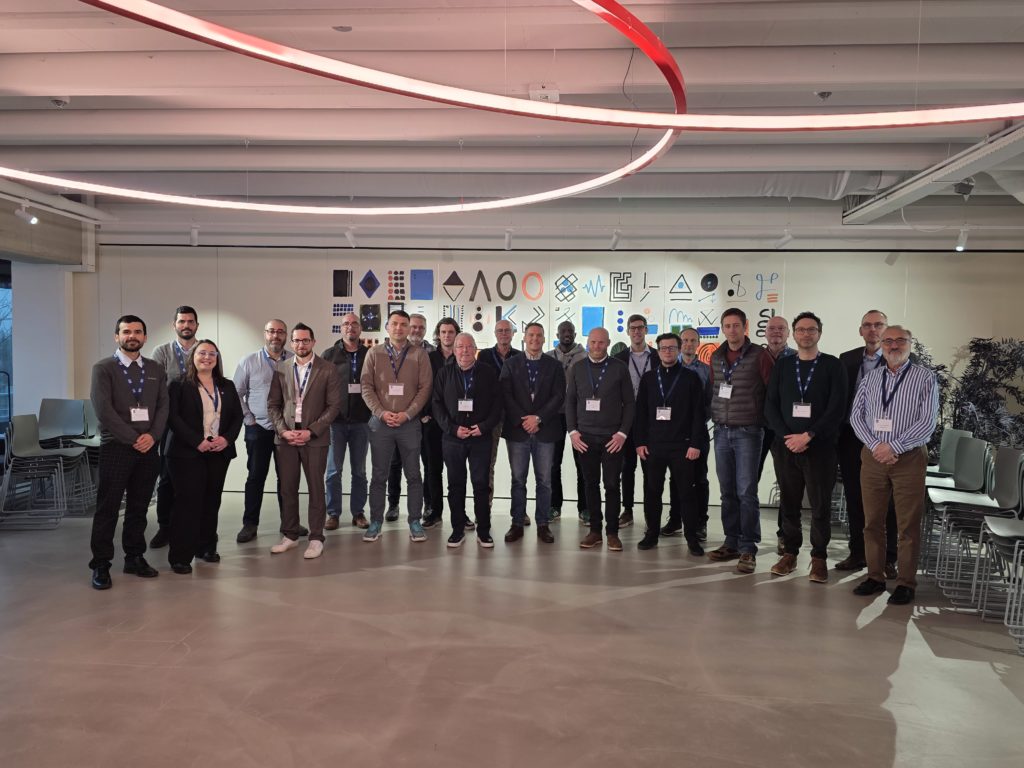
The H2FlowTrace consortium held its mid-term project meeting on 24 and 25 February, during which they reviewed the project’s progress. The meeting, held at the Dutch National Metrological Institute (VSL) in Delft (Netherlands), was attended by all partners, who assessed the project’s status across different work packages. The meeting also included visits to VSL’s low-pressure gas (air) flow lab and VSL’s European Centre for Flow Measurement in Rotterdam (Netherlands).
On the first day, representatives from VSL and Cesame Exadébit (project coordinator) welcomed the attendees. Marc de Huu, head of the laboratory at the Swiss Federal Institute of Metrology (METAS), explained the progress made in establishing metrological infrastructure for the traceability of pure hydrogen flow and natural gas enriched with hydrogen (HENG) flow for small industrial gas meters. Among the milestones, the calibration of six similar-sized Critical Flow Venturi Nozzles (CFVN) with the Small-Scale Transfer Skid (SSTS) to enhance the traceability of hydrogen, carried out at the end of 2025 at the Natran R&I facilities in Alfortville (France), followed by a recent second campaign to calibrate the two master meters to be installed on the future Large-Scale Transfer Skid (LSTS) conducted at DNV’s technology centre in Groningen (Netherlands).
The data obtained will be used to establish traceability for hydrogen flows at higher rates. This was precisely the central theme of the presentation of Hans-Benjamin Böckler, Senior Researcher at German National Metrology Institute, explaining the current status of this part of the project. Meanwhile, Menne Schakel, Chief Scientist Flow at VSL, analysed the development of the design and assembly of transfer skids to deliver traceability for hydrogen and hydrogen blends, highlighting the milestone of the validation of the SSTS and the design of the LSTS. To conclude the first day, the consortium visited VSL’s low-pressure gas (air) flow lab in Delft.
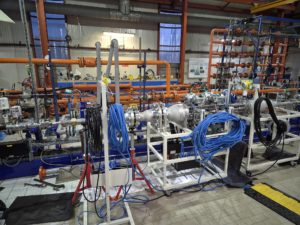
The second day began with another visit, this time to VSL’s European Centre for Flow Measurement in Rotterdam. Participants saw first-hand the LSTS being assembled for H2FlowTrace while visiting other parts of the facility, including the volume labs, water flow, the liquified natural gas research and calibration facility, and the high-pressure natural gas flow piston prover, which was already used in the project for the calibration of industrial gas flow meters on natural gas and HENG.
Afterwards, Marc MacDonald, Head of Hydrogen Metrology at TÜV SÜD, reported on the selection of domestic and industrial gas meters for the upcoming calibrations. He underscored the value of the stakeholder workshop in 2025, which helped identify the most relevant flow meter technologies. Miguel Ballesteros, Programme Delivery Manager at European Gas Research Group (GERG), then explained the impact the project has had through its social networks, the engagement of stakeholders, dissemination to standardisation bodies, as well as the presence at key conferences and events. Finally, Rémy Maury, Director General of Cesame-Exadébit, and Lucie Dangeon-Vassal, Research Engineer at Cesame-Exadébit (project coordinator), concluded the meeting by underlining the significance of the work done so far, but also the challenges that the consortium is ready to embrace during the second half of H2FlowTrace.