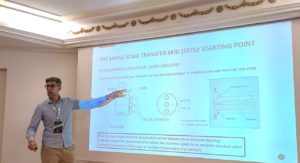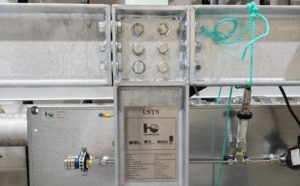

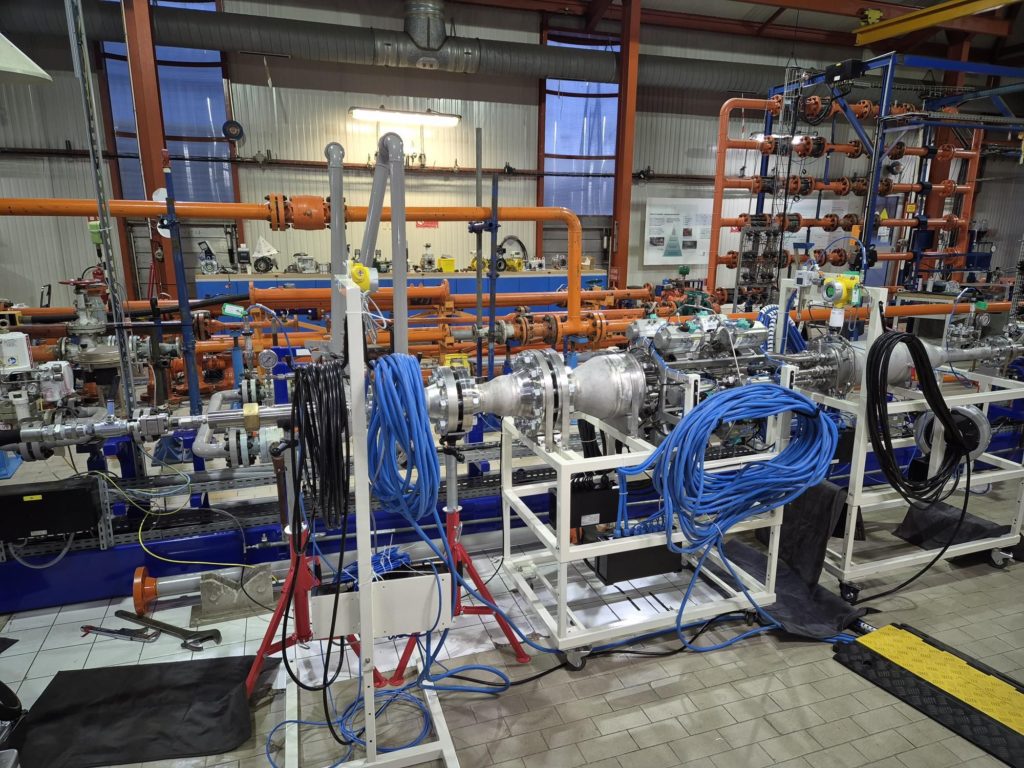
The H2FlowTrace consortium has set another milestone in the project by calibrating six Critical Flow Venturi Nozzles (CFVN) through a Small-Scale Transfer Skid (STSS) in December 2025. This will be a key tool for providing traceability to several master meters in pure hydrogen and, possibly, also in Hydrogen Enriched Natural Gas (HENG). The flow measurement team at Natran R&I in Alfortville (France) led this task, in collaboration with CESAME EXADEBIT, the Swiss Federal Institute of Metrology METAS, TÜV SÜD UK’s National Engineering Laboratory (NEL) and the German National Metrology Institute (PTB).
The calibration was carried out in a facility designed and built by NaTran, with support from Cesame and METAS, and following the test protocol set by NEL. NaTran individually calibrated the six CFVNs (covering 120kg/h – 1.300 m³/h at 0,1 MPa and 45 m³/h at 3,3 MPa), with support from Cesame, METAS, NEL and PTB. The calibrations were performed on the BMC-H₂ sonic-nozzle test bench using the SSTS. These tests enabled the calibration of six sonic nozzles over a pressure range of 7 to 35 bar, with flow rates of up to 1.200 Nm³/h (120 kg/h).
Moreover, one of the 6 CFVNs was calibrated with natural gas to demonstrate transferability between alternative gas calibration and hydrogen calibration for CFVN (sonic nozzle), at a large mass flow rate of up to 120 kg/h. These calibrations have been carried out using a first set of six nozzles calibrated with hydrogen on a primary standard at Cesame for low flow rates (up to 20 kg/h).
This step is a key milestone in the implementation of the future traceability chain for measuring high H₂ flows, which is necessary to certify and calibrate the industrial meters to be installed on our future H₂ transport networks. The tests carried out in December at NaTran R&I are the first building block of the future H₂ traceability chain in Europe. These advances contribute directly to the development of methods and calibration benches for pure hydrogen and hydrogen-natural gas mixtures, meeting the metrological reliability challenges necessary for the evolution of gas networks.